Tag Archive for: Bioeconomy

What If We Looked at Our Resources Differently?

Before we ask how to produce more, perhaps we should ask whether we have understood the full value of what we already have.

For generations, we have built industries around a relatively simple question:

“What can we make from this resource?”

We grow a crop for a particular product. We harvest seaweed for a particular application. We process food to recover the component we want. We treat wastewater primarily to make it safe for disposal or reuse.

And once those systems have been established, we tend to keep improving them, by making them faster, bigger, more efficient. And usually, more costly…

But perhaps there is a more fundamental question we should be asking first:

“What value does this resource actually contain?”

Not what have we traditionally used it for.

Not what our existing processing infrastructure was designed to produce.

Not even what today’s market currently values most highly.

But what is in it? What could be recovered from it? And what could it become?

Only then should we ask: How should we process it? That reversal in thinking may seem subtle, but it has profound implications.

Designing the process around the resource

Too often, we approach biological resources with the processing method already decided.

The resource is made to fit the process.  What if we reversed that?

Imagine beginning with the biological resource itself and mapping its potential value: proteins, fibres, minerals, oils, pigments, nutrients, bioactive compounds, carbohydrates and other potentially useful fractions.

Then, instead of asking which of these survives our existing process, we ask:

“What processing approach would allow us to preserve and recover the fullest possible value?”

The process is designed around the resource.  Not the resource around the process.

This is the thinking behind Value Unlocking and Value Recovery.

Value Unlocking is about recognising potential that may previously have been overlooked.

Value Recovery is about designing systems capable of retaining and recovering more of that value.

Together, they ask us to look at familiar resources through an unfamiliar lens.
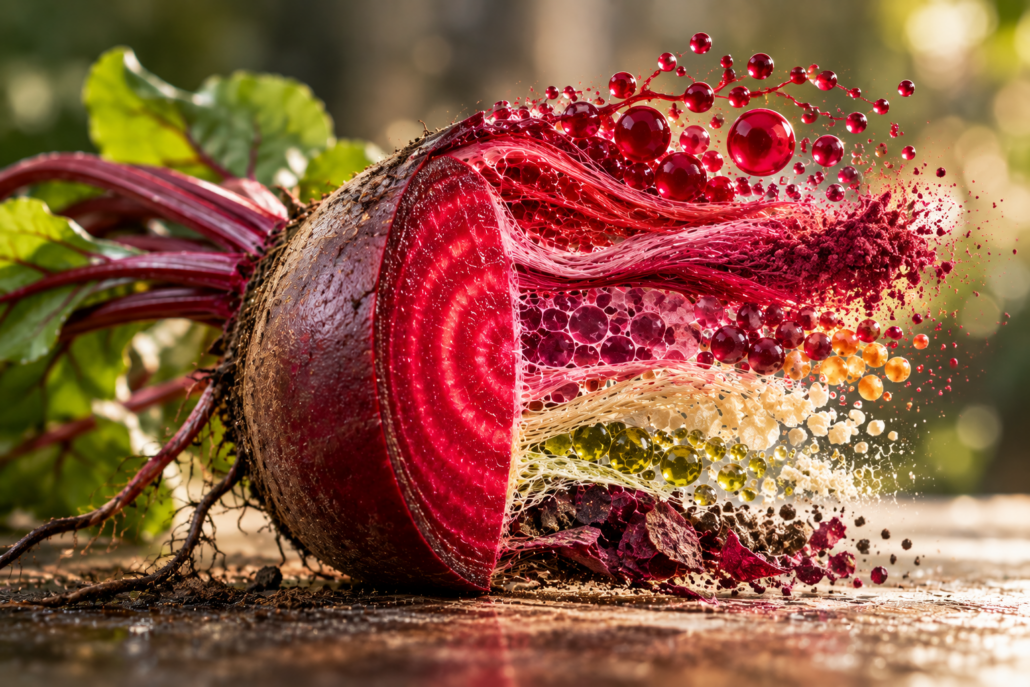
The same resource. A different question.

This matters because many of the resources we describe as constrained, low-value or waste may not necessarily be so.

They may simply be under-understood and under-utilised. For example:

A tonne of seaweed remains a tonne of seaweed.

A beetroot remains a beetroot.

A citrus fruit remains a citrus fruit.

Agricultural residues, spent grain and organic effluent remain physically what they were yesterday.

But their economic potential can change dramatically when we stop asking: “What do we normally do with this?”

and begin asking: “What else is here?”

That is a very different starting point for innovation.

Before producing more, recover more

This shift also challenges one of the assumptions underpinning modern industrial growth.

When demand increases, our instinct is usually to produce more.

More hectares.

More biomass.

More yield.

More extraction.

More throughput.

Sometimes that will be necessary.  But on a planet facing increasing pressure on land, water, energy and natural systems, there is another option we should investigate first: Can we derive more value from the resources we are already producing?

If we can recover more useful outputs from the same biological input, productivity begins to mean something different.  It is no longer simply yield per hectare or tonnes per hour.

It becomes: value recovered per unit of resource.

That could be one of the more important measures of productivity in the emerging bioeconomy.

Waste looks different through this lens

It also changes how we think about so-called ‘waste’.

Waste is generally treated as something that exists at the end of a process.

We then invest enormous effort trying to recycle it, repurpose it, dispose of it more responsibly or find another market for it.

Those efforts remain important.  But Value Recovery asks an earlier question:

“Why did so much value become waste in the first place?”

If useful compounds are destroyed, diluted, discarded or rendered uneconomic during processing, the opportunity to recover them may already have been lost.

So perhaps the most effective place to address waste is not always at the waste stream.

Perhaps it is at the beginning of the process.

A different lens

None of this requires us to abandon the infrastructure, industries or knowledge we already have. It does, however, ask us to interrogate them.

Science has given us an extraordinary understanding of the complexity contained within natural resources.  Technology increasingly gives us new ways of accessing that complexity.

The opportunity now is to bring those two things together.

At Green Cell Technologies, we believe this requires a shift from simply processing biological resources towards understanding, unlocking and recovering their value.

Our own technology is one expression of that thinking.

But the principle is much bigger than any single technology or company.

It is a question that can be asked of a crop, a forest, seaweed, a food manufacturing stream, wastewater or almost any biological resource: “What value is already here that we are failing to see?”

Because sometimes innovation does not require a new resource.  Sometimes it begins by looking differently at the one already in front of us.

Same resource. Different lens. Greater value.

Roy Henderson is CEO of Green Cell Technologies® (GCT®), a biotechnology company developing and licensing processing technology built around Value Unlocking and Value Recovery – identifying and recovering greater value from existing biological resources.

Get in touch to discover, unlock and recover the best value in your existing resources and systems by emailing info@greencelltechnologies.com
Food Security in an Age of Compounding Shocks

War, climate and disrupted supply chains are exposing the fragility of how we grow food. Perhaps resilience begins by making better use of the biological resources already available to us.

“Food security cannot depend indefinitely on everything going right at the same time. We need agricultural systems capable of functioning when things go wrong.” – Roy Henderson, CEO, Green Cell Technologies®

The modern food system is an extraordinary feat of global co-ordination.

Energy is produced in one part of the world. Fertiliser in another. Crops somewhere else. Ships move between them. Farmers plant according to relatively predictable seasons, and global supply chains keep the inputs moving.

Until they don’t.

In 2026, several pressures that would normally be considered individually are occurring simultaneously.

Conflict is disrupting energy and fertiliser production. Critical shipping routes are under pressure.  Fertiliser prices have risen sharply. El Niño presents additional risks to agricultural production. And farmers must somehow absorb all of this while continuing to produce affordable food.

The question is no longer whether any single shock can be managed.

It is how many shocks the global food system can absorb at the same time.

Fertiliser has become a geopolitical vulnerability.

The scale of the world’s dependence on a small number of trade routes is striking.

According to the International Energy Agency, more than 30% of globally traded urea passes through the Strait of Hormuz, together with approximately 20% of traded ammonia and phosphate and around half of global seaborne sulphur – all important to fertiliser supply chains.

The Food and Agriculture Organization (FAO) recently reported that tanker movements through the Strait had fallen by more than 90%, with an estimated 1.5–3 million tonnes of fertiliser trade being delayed each month.

FAO Director-General Qu Dongyu has warned that fertiliser scarcity resulting from the disruption could translate into “lower yields and tightening food supplies” through the latter part of 2026 and into 2027.

The economics are already changing.

The World Bank forecasts fertiliser prices to increase by approximately 31% in 2026, driven partly by a 60% increase in urea prices. The International Energy Agency reports that urea prices doubled between January and May.

For farmers, particularly in import-dependent economies, fertiliser is therefore becoming not merely an agricultural input.

It is becoming a geopolitical risk.

And then there is climate

Layer climate volatility over these disruptions and the vulnerability becomes more apparent.

The World Bank has identified the potential combination of El Niño, elevated energy and fertiliser costs, biofuel demand and trade restrictions as significant risks to global food markets during 2026.

This does not mean the world is inevitably heading towards a global famine. On paper, global cereal stocks remain relatively comfortable by historical standards.

But global availability is not the same as food security.

Food has to be affordable, accessible – and able to move from where it is produced to where it is needed.

That distinction is particularly important for Africa and the Middle East. 

Russia and Ukraine together account for around one-third of global wheat trade, much of it traditionally moving through Black Sea ports. Ukraine alone has historically been a major source of affordable grain for countries across Africa, the Middle East and Asia.

So grain sitting in a silo in Ukraine or Russia does little for a food-importing country if Black Sea routes are constrained, shipping costs soar, fertiliser prices rise and another critical route through the Red Sea or Strait of Hormuz is simultaneously disrupted.

The World Food Programme now describes these simultaneous pressures across the Black Sea, Red Sea and Strait of Hormuz as a potential “triple chokepoint” for global food security.

The danger, therefore, is not simply that the world runs out of grain.

It is that food and the inputs required to produce it become increasingly expensive, inaccessible or stranded in the wrong place – while the populations most dependent upon imports are least able to absorb the shock.

That should make us think differently about resilience.

If fertiliser becomes significantly more expensive or difficult to obtain at precisely the moment crops are experiencing greater heat, drought, salinity or other environmental stresses, simply trying to maintain the existing agricultural model becomes increasingly difficult.

Perhaps the question shouldn’t only be: Where will we get enough fertiliser?

It should also be: How can we help plants make better use of the resources available to them?

Looking to the sea

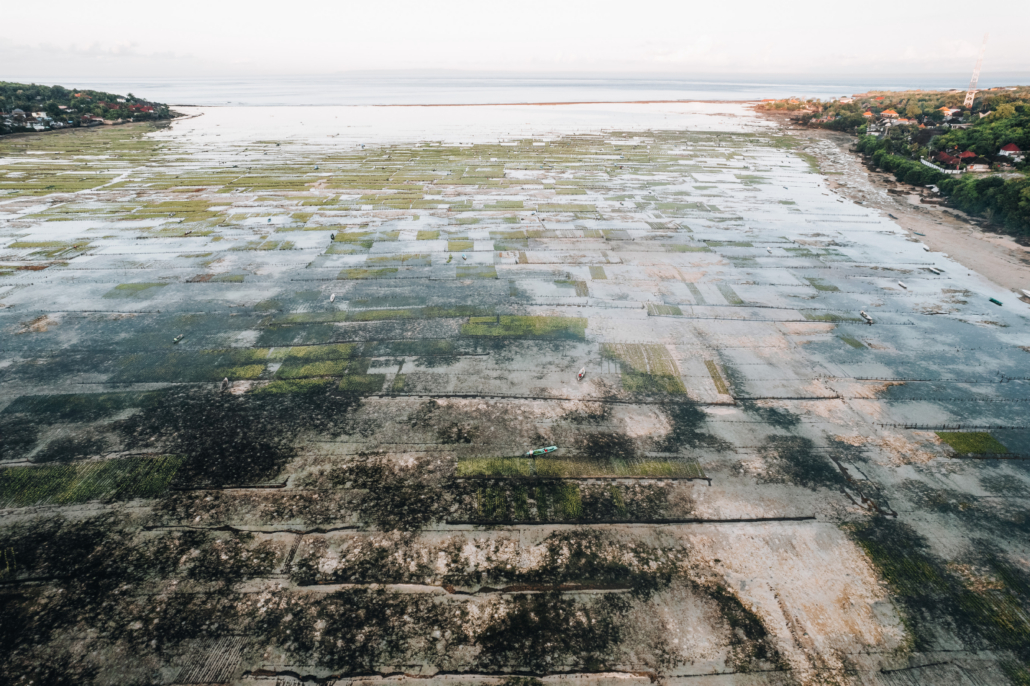
Aerial Drone Photo of Seaweed Farms in Nusa Lembongan Ceningan Bali Indonesia. High quality photo

This is where seaweed becomes interesting.

Seaweed-derived agricultural bio-stimulants are attracting increasing scientific attention because of their ability to influence plant growth, nutrient-use efficiency and responses to environmental stress.

They are not replacements for nitrogen, phosphorus and potassium.

NPK fertilisers provide essential plant nutrients.  Bio-stimulants work differently.

Research published in the Journal of Biotechnology describes seaweed-derived bio-stimulants as containing diverse bioactive compounds – including polysaccharides, proteins, polyphenols and vitamins – associated with improved plant growth, stress tolerance and soil health.

Other research points to seaweed polysaccharides that can support water retention, nutrient uptake and plant performance under conditions including drought, salinity and extreme temperatures.

In other words, fertiliser feeds the plant.

Bio-stimulants can potentially help the plant use what it has more effectively and cope better when conditions become difficult.

In a world of increasingly expensive inputs and climatic stress, that distinction matters.

From Sargassum problem to biological resource

Then consider Sargassum.

Enormous seasonal influxes of the seaweed have created environmental and economic problems across parts of the Caribbean and Atlantic. The conventional starting point is understandable:

How do we get rid of it?

But what happens if we ask a different question?

What value does it contain?

Recent research has already investigated Sargassum-derived agricultural products. A 2026 study of a Sargassum-based liquid bio-fertiliser used on tomatoes found increased availability of several soil macronutrients during the study.

Importantly, the research also illustrates why processing matters.

Raw Sargassum can contain high levels of salt and potentially concerning trace elements, including arsenic.  It cannot simply be collected from a beach and spread indiscriminately across agricultural land.

The resource must be understood, undesirable components must be identified, and the valuable components must be recovered safely and effectively.

The processing method must be designed around the chemistry of the resource.

That is Value Recovery in practice.

GCT’s role: recover more from what already exists

At Green Cell Technologies, we see two opportunities emerging from this changing food-security landscape.

The first is agricultural resilience – using technologies such as the Disruptor® to process seaweed and other biological resources differently may enable greater recovery and availability of useful compounds for bio-stimulant applications.

That could include cultivated seaweeds, existing marine biomass and, where appropriate and properly characterised, problematic biomass such as Sargassum.

The objective is not to claim that seaweed can replace conventional fertiliser. It is more interesting than that:  Can biological inputs help farmers make every kilogram of fertiliser, every litre of water and every hectare of productive land work harder?

The second opportunity is on the other side of the farm gate – it is meaningful nutrition.

Food security should not be measured solely in tonnes or calories.  Our crops, food-processing streams and agricultural by-products contain proteins, fibres, micronutrients and functional compounds that conventional processing does not always fully recover.

Value Recovery asks how we can retain and recover more of that nutrition from resources already being produced.

Put simply:

Help the plant derive more from its environment.

Then help humanity derive more from the plant.

Resilience through value

None of this means that conventional fertiliser is unnecessary.

Nor does it mean that a single technology can insulate agriculture from war or climate change.

The challenge is larger than that.

Indeed, in August, the World Bank and other multilateral development institutions called not only for stronger fertiliser supply chains but also for improved fertiliser-use efficiency, diversified nutrient sources, healthier soils and more resilient food systems.

That is the direction in which we need to move.

The current crisis should not be welcomed.  Fertiliser scarcity threatens farmers, yields and ultimately food affordability.

But it does expose something we can no longer ignore.

A food system dependent upon concentrated sources of energy, fertiliser, favourable weather and uninterrupted global shipping is vulnerable when several of those assumptions fail simultaneously.

Resilience will require diversification.  It will require better soil management, smarter use of fertiliser and new biological inputs.  And it will require us to look much more carefully at resources we already have – on farms, in oceans and within existing food-production systems – and ask:

What value is already here that we haven’t yet learned to recover?

Because the answer to food insecurity cannot always be to produce more.  Sometimes resilience begins with getting considerably more from what we already have.

Roy Henderson is CEO of Green Cell Technologies® (GCT®), a biotechnology company developing and licensing processing technologies centred on Value Unlocking and Value Recovery.

Value Recovery: Unlocking More Value from Biomass

Recovering value is becoming more important than producing volume.

“The greatest untapped natural resource isn’t hidden beneath the ground. It’s already being harvested every day.” [Roy Henderson, CEO GCT®]

For more than a century, industrial progress has been measured in volume.  More steel.  More coal.  More wheat, timber, fish, milk, oil and so on…

More production has almost always been seen as the pathway to greater prosperity.

But biology and nature do not work like mining.

Every biological resource already contains extraordinary complexity and value.  Plants, algae, fungi and agricultural crops are sophisticated chemical factories, producing proteins, fibres, pigments, antioxidants, minerals, enzymes and thousands of bioactive compounds through millions of years of evolution.

Yet modern industry often extracts only a fraction of that value.

The remainder is downgraded into low-value applications – or simply discarded.  That is not because the value isn’t there.  It is because our processing systems were largely designed for an era that prioritised volume over optimisation.

Today, however, the pressures facing society have changed.

Growing populations, finite natural resources, climate change and increasing demands on land, water and energy mean that producing ever more biomass is becoming both harder and more expensive.

Perhaps we have reached the point where the most important question is no longer: “How do we produce more?”  Perhaps it is: “How do we recover more from what we already produce?”

That subtle shift changes everything.  Suddenly, agricultural residues become feedstocks.  Food processing by-products become future ingredients.  Marine biomass becomes a platform for multiple industries rather than a single commodity.

Success is no longer measured by tonnes harvested.  It is measured by value recovered.

This is not simply an engineering challenge.  It is an economic one.

Imagine two processors receiving exactly the same tonne of biological material.  One extracts a single product.

The other develops multiple revenue streams from the same biomass.

Both handled the same raw material.  One created a commodity.  The other created an ecosystem.

That difference will increasingly determine which companies and countries succeed in the emerging bioeconomy.

Around the world we are seeing governments invest heavily in growing biomass production.

That investment is important.  But production alone will not unlock prosperity.

The real opportunity lies in recovering more value from every harvest, every crop, every marine resource and every biological feedstock.

In many respects, the next industrial revolution has already begun.  It is no longer about producing more biological material.  It is about understanding its hidden potential.

At Green Cell Technologies®, we believe this is one of the defining industrial opportunities of our time.

Not because of one technology.  But because the world can no longer afford to leave so much value behind.

The future belongs to those who recover more.

If you would like to know how you can recover and/or create more value from what you are already doing, then get in touch…info@greencelltechnologies.com

The Bioeconomy Has a Missing Middle – and It’s Processing

A recent FoodNavigator article on functional beverages highlights a challenge that extends far beyond drinks.

The article makes a simple but important point: functional beverages can no longer rely on health claims alone.  Consumers expect products that taste good, deliver credible benefits, feel natural, are priced correctly, and fit into their everyday lives.

That is not just a branding challenge. It is a processing challenge – across the bioeconomy.

The world is investing heavily in promising raw materials. Think seaweed, botanicals, plant proteins, fruits, vegetables, fibres, agri-residues, fly larvae and other biological inputs. Far less attention, however, is paid to the processing layer that determines whether those materials become commercially viable products.

This is the missing middle.

It is the space between what we grow, harvest or collect, and what the market can actually use.

In seaweed, cultivation is advancing, but value is often lost after harvest through outdated, selective or waste-heavy processing methods.

In functional beverages, brands may have access to exciting ingredients, but if processing compromises flavour, texture, stability or bioactivity, the product struggles to deliver.

In plant proteins, performance is shaped not only by the crop, but by how fibres, cells and particulates are treated.

In nutraceuticals and botanicals, the commercial value often depends on how effectively bioactive compounds are released and preserved.

In agri-waste and side-streams, the opportunity is not simply to “use waste”, but to process it intelligently enough to create new value.

In almost every one of these streams, poor or incomplete processing creates waste – either as new by-products, degraded material, spent biomass, or simply unprocessed potential left behind. This means industries are often paying to grow, harvest, transport and handle biological materials, only to discard a significant portion of their value at the processing stage.

The market is not short of biological potential.

It is short of processing systems that can unlock that potential fully, efficiently and consistently.

At Green Cell Technologies, this is where we believe the next major shift will happen.

Our Disruptor® platform, powered by Dynamic Cellular Disruption® (DCD®), is designed to mechanically open cell structures, micronize fibres, fragment fine particulates and sterilise processed material – in a single continuous process with no denaturing. 

That matters because processing is no longer a back-end technical step.

  • It affects yield.
  • It affects taste.
  • It affects texture.
  • It affects bioavailability.
  • It affects waste.
  • It affects cost.
  • It affects whether a product can scale.
  • If the bioeconomy is to deliver on its promise – healthier foods, better ingredients, cleaner industrial inputs, circular value chains and reduced waste – then processing has to move to the centre of the conversation.

The future will not be decided only by what we grow.  It will be decided by how intelligently we process it.

Processing is where biological potential becomes commercial value.

Get in touch with us: info@greencelltechnologies.co.za