
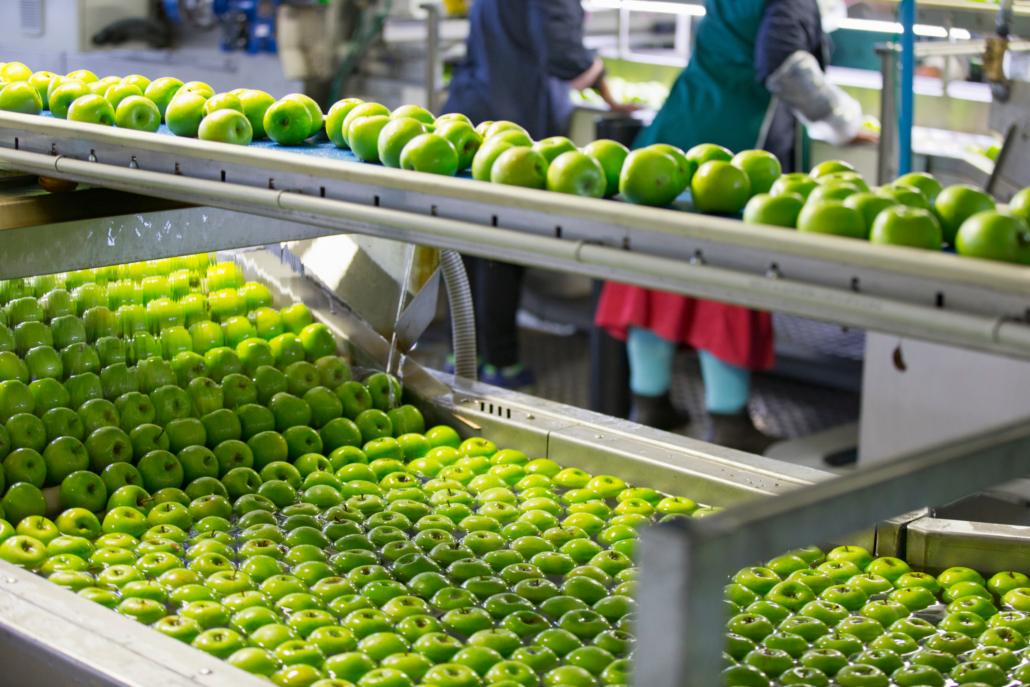
When Food Formulation Changes, Can the Processing Line Keep Up?
New industry research reveals how changing ingredient requirements are reshaping food manufacturing – and why processing capability is becoming an increasingly important investment decision.
Fi Europe 2026 concluded in Frankfurt last week, with the food ingredients industry examining some of its most pressing challenges: improving nutritional profiles, developing functional ingredients and balancing consumer expectations with manufacturing costs.
But behind every new formulation lies another question.
Can the processing technology deliver what the ingredient developer has designed?
It is a question with significant implications for food manufacturers evaluating new products, production methods and capital investment.
Food manufacturers are being asked to achieve more with increasingly complex formulations.
More fibre. More protein. Less sugar. Cleaner labels. Better texture. Greater consistency.
And preferably without increasing production costs.
These requirements are creating challenges that extend well beyond ingredient selection. They are changing what manufacturers need from their processing equipment, how production lines are configured and where capital investment may be required.
Recent industry research suggests that the relationship between food formulation and processing technology deserves far greater attention.
Because developing a better ingredient is one challenge. Manufacturing it consistently, efficiently and at commercial scale is another.
Formulation is changing the factory

An October 2026 report from PMMI — The Association for Packaging and Processing Technologies, The Formulation Effect: Impacts on Food & Beverage Production, Equipment and Investment provides an indication of how these changes are affecting manufacturers.
Based on research involving food and beverage manufacturers and equipment suppliers, PMMI reported that:
- 63% of surveyed end users identified mixing and blending as a production process particularly affected by enhanced formulations.
- 51% of surveyed end users anticipated at least US$500,000 in related processing or packaging investment over the following three years.
- 47% reported that enhanced nutritional or functional formulations already represented more than 10% of their production volumes.
These findings reflect the report’s surveyed participants, rather than the entire global food-processing industry. Nevertheless, they point to an important development.
Changes in formulation are creating changes in equipment requirements.
A new ingredient may alter viscosity, flow behaviour, mixing requirements, cleaning procedures or product stability.
For manufacturers, the challenge is no longer simply identifying an ingredient that delivers the desired nutritional or functional characteristics.
It is ensuring that the production system can handle that ingredient reliably and economically.
Ingredient innovation comes with manufacturing consequences
At Fi Europe 2026, ingredient manufacturer Ingredion highlighted the growing complexity of food reformulation.
In a 19 November interview with Food Ingredients First, the company discussed the need to balance increased protein and fibre content, sugar reduction, texture, flavour and affordability.
One particularly important point emerged: reformulating individual ingredients in isolation can increase costs.
Manufacturers increasingly need to consider how the entire formulation works together.
But there is another dimension to that discussion.
What happens when the processing technology itself influences the characteristics of the ingredient?
Could an alternative processing method change the texture or physical behaviour of a fruit or vegetable preparation?
Can different treatments of fibre affect how an ingredient performs in a finished formulation?
Could a manufacturer investigate new product formats without assuming that conventional separation and processing steps are the only available options?
These are questions that require practical investigation rather than assumptions about what a technology can deliver.
The challenges are different. The processing questions are connected.

Consider several food-processing applications:
Citrus: functionality and flavour
Citrus processors work with raw materials containing juice, fibre, pectin and naturally occurring compounds with potential ingredient applications.
Incorporating different fruit fractions into finished products can create opportunities, but also introduces challenges.
Peel components may affect bitterness. Fibre characteristics may influence texture and viscosity. Particle size and product stability can determine suitability for particular formulations.
The commercial opportunity depends on producing an ingredient that meets a defined specification — not simply incorporating more of the fruit.
Tomatoes: beyond traditional product formats
Tomato processors manufacture products ranging from concentrates and sauces to purées and ingredient preparations.
Different applications demand different characteristics, including texture, consistency, solids content, colour and sensory performance.
GCT has undertaken repeated tomato-processing trials using Dynamic Cellular Disruption® technology, including the development of a tomato sauce preparation.
The relevance is not that one processing approach will necessarily outperform every established method.
It is that alternative processing capabilities can be evaluated against specific product requirements.
Vegetable ingredients: processing affects the finished product
Beetroot provides another useful example.
Its naturally occurring pigments, nitrates, fibre and other constituents make it relevant to a range of food and ingredient applications.
However, powders and purées are not interchangeable products.
Their performance depends on the complete manufacturing process, including any drying, storage and subsequent formulation stages.
GCT’s beetroot trials and associated analytical comparisons illustrate why ingredient composition and processing methods deserve investigation. They do not, on their own, establish that every observed difference is attributable exclusively to DCD®.
Brewers’ spent grain: functionality from secondary streams
Brewers’ spent grain contains fibre, protein and other constituents with potential food-ingredient applications.
But converting a wet secondary stream into a consistent ingredient involves challenges including moisture management, microbiological quality, texture, shelf life and downstream processing.
GCT has undertaken DCD® processing work with brewers’ spent grain.
The next question for any prospective manufacturer is whether the resulting material can meet a specific ingredient requirement at a commercially viable processing cost.
Across these applications, the common issue is not the raw material itself.
It is the relationship between material characteristics, processing technology, finished-product requirements and manufacturing economics.
Processing technology must be assessed as part of the complete system
A 2026 scientific review, Sustainable Processing in Food Manufacturing, published in the Annual Review of Food Science and Technology, examines how processing-system redesign, more efficient unit operations and functionality-oriented formulation can influence food manufacturing.
The review considers opportunities associated with alternative processing methods and more effective raw-material utilisation.
It also reinforces an important principle: meaningful improvements often require assessment of the complete processing system rather than individual operations in isolation.
This is particularly relevant when evaluating new equipment.
A technology may produce a promising intermediate ingredient, but its commercial viability depends on what happens before and after that processing step.
Preparation, downstream drying where required, handling, storage, sanitation, energy consumption and integration into existing infrastructure all influence the final economics.
A successful laboratory or pilot trial is therefore a starting point, not proof of a commercially superior manufacturing process.
Where Dynamic Cellular Disruption® enters the conversation
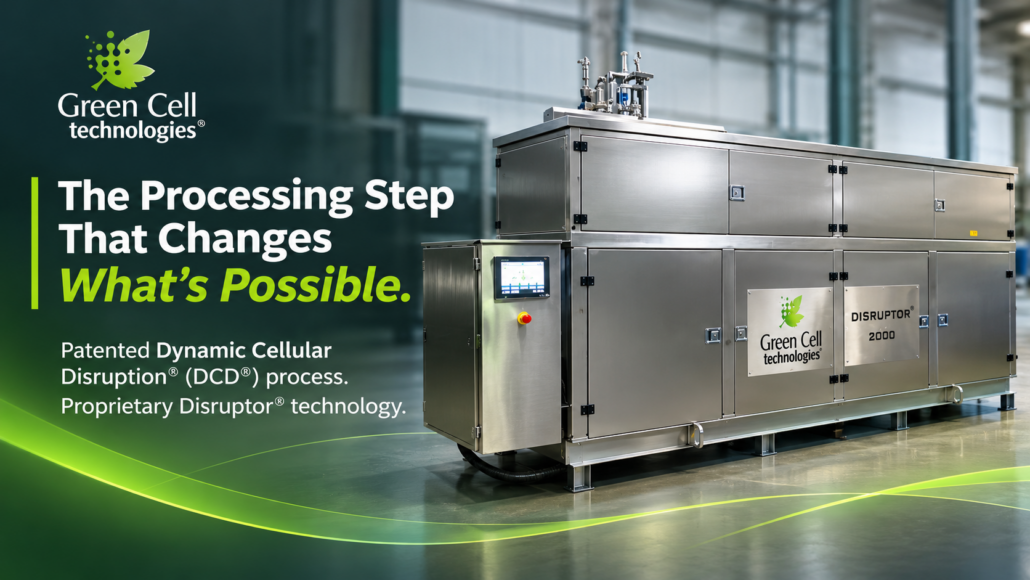
At Green Cell Technologies®, we approach these challenges through our patented and commercially scaled, Dynamic Cellular Disruption® (DCD®) technology, delivered through the Disruptor® platform.
The technology processes appropriately prepared biological materials through rapid cellular disruption.
GCT has undertaken trials across multiple food-processing applications, investigating purées, ingredient intermediates, fibre characteristics and other product-development possibilities.
The Disruptor® is designed as a continuous-flow processing system and can be evaluated as part of an existing manufacturing operation or a new production configuration.
It does not replace every unit operation. Where powders are required, for example, drying remains a separate downstream process.
Those characteristics must be demonstrated through appropriate analysis and application-specific testing.
The question for manufacturers is whether the technology can contribute to an ingredient or processing outcome that meets their requirements and supports a viable commercial case.
The investment decision is changing
A further PMMI report published on 17 November 2026, Food & Beverage Processing Trends, identifies equipment flexibility, hygienic design, automation and operating efficiency among the considerations shaping food-processing investment.
These priorities are closely connected.
Manufacturers cannot evaluate a new processing capability solely on the characteristics of its output.
They must also consider production capacity, reliability, maintenance, sanitation, integration and the economics of operating the complete line.
For equipment developers, this places greater emphasis on practical evidence.
For manufacturers, it suggests that technology investment should begin with a clearly defined processing or product-development problem.
What needs to change?
What must the finished product achieve?
What would constitute a measurable improvement?
And what evidence would justify investing in a different processing approach?
From formulation challenge to manufacturing opportunity
The food industry is not short of new ingredient ideas.
What is becoming increasingly important is the ability to manufacture those ingredients consistently, at the required scale and at a cost the market can support.
That requires closer collaboration between ingredient developers, food scientists, process engineers, equipment manufacturers and commercial decision-makers.
It also creates an opportunity to reconsider whether existing production methods are always the best fit for emerging ingredient requirements.
At Green Cell Technologies®, we believe this is where application-specific processing trials have an important role.
By examining the raw material, intended product, processing requirements and commercial objectives together, manufacturers can determine whether alternative technology offers a worthwhile route forward.
Because the next food-processing investment should not begin with the machine. It should begin with the problem the manufacturer needs to solve.
Is your processing line limiting your next product?
Green Cell Technologies® works with food manufacturers to investigate application-specific processing challenges through DCD® trials and the potential integration or licensing of Disruptor® equipment.
To discuss a processing challenge or explore a technical evaluation, contact info@greencelltechnologies.com.





 Green Cell Technologies
Leave a Reply
Want to join the discussion?Feel free to contribute!